
Southeast Drought Deepens Ahead of Summer, Raising Heat, Fire and Water Concerns
A dry spring replaces the Southeast’s usual stormy season
Spring in the Southeast is often associated with frequent rain, thunderstorms and bouts of severe weather. This year, the season has taken a different turn. Instead of persistent wet patterns, drought has become the defining concern across much of the region as summer draws closer.
The scope of the dryness is not limited to a handful of counties or a single state. The drought has expanded and intensified across the Southeast, and the shift is substantial even when the percentage changes sound small. Regional coverage of severe and extreme drought has increased by about 10% in each category. In a region where nearly all areas are already experiencing drought, that kind of increase signals a meaningful worsening of conditions rather than a minor fluctuation.
Nearly the entire region is now in drought
Current conditions show drought affecting virtually every corner of several Southeast states. Every part of Georgia, South Carolina, North Carolina, Virginia, Tennessee and Alabama is experiencing drought conditions. Arkansas and Florida are both reported to be 99% in drought.
Florida stands out for the severity of its situation. The state is experiencing its worst drought in 25 years. That distinction matters not only for residents, but also for anyone planning travel or outdoor activities during the coming months, when heat and dry vegetation can amplify impacts.
How the drought took hold: from last fall to a dry spring
The current drought did not emerge overnight. The Southeast has been dealing with drought conditions since last fall, and the dryness has persisted through winter and into spring.
One key driver was the La Niña pattern that influenced the United States this past winter. In the Southeast, La Niña typically brings a warmer and drier winter, and that is what occurred. Rather than a return to wetter conditions in spring, the region transitioned into a dry spring as well, compounding deficits that had already built up.
The result has been an unusually dry season for many major cities. According to the Southeast Regional Climate Center, a long list of locations are currently experiencing one of their top 10 driest spring seasons to date. Those cities include:
- Atlanta
- Savannah
- Tallahassee
- Charleston
- Charlotte
- Raleigh
- Richmond
- Memphis
- Nashville
- Montgomery
When dryness is widespread across both urban centers and surrounding rural areas, the impacts can extend beyond lawns and gardens. Low soil moisture, stressed vegetation and reduced water availability can ripple through agriculture, public water systems and outdoor recreation.
Record dryness documented across multiple states
Drought monitoring reports underscore how exceptional the recent period has been. Drought.gov notes that Georgia, North Carolina and South Carolina experienced record dry conditions for September 2025 through March 2026, with records dating back to 1895.
The same report places other states among their driest on record for that September–March period:
- Alabama: second driest
- Florida: third driest
- Tennessee: ninth driest
- Virginia: 10th driest
These rankings help explain why drought coverage has become so extensive. When precipitation deficits accumulate over multiple seasons, it becomes harder for short-lived rain events to reverse the trend.
A brief pattern change may bring rain, but not a reset
There is some near-term relief in the forecast, though it is limited. A pattern change is expected to bring some rain to the parched Southeast over the next seven days. However, the totals in the hardest-hit areas may be modest.
Forecast amounts suggest that parts of Florida and Georgia—where drought is among the worst—could see only about a half inch of rain or less. Other areas may do somewhat better. Totals of 1 to 3 inches are forecast for parts of the Tennessee and Mississippi Valleys, which would be helpful but are not expected to eliminate drought conditions.
Arkansas is one place where heavier rainfall is possible. Forecast models are hinting that parts of the state could see up to 5 inches. Even so, a single wet week does not necessarily erase long-term deficits, especially when soils are dry and broader regional patterns remain unfavorable.
Will this rainfall end the drought? The outlook says no
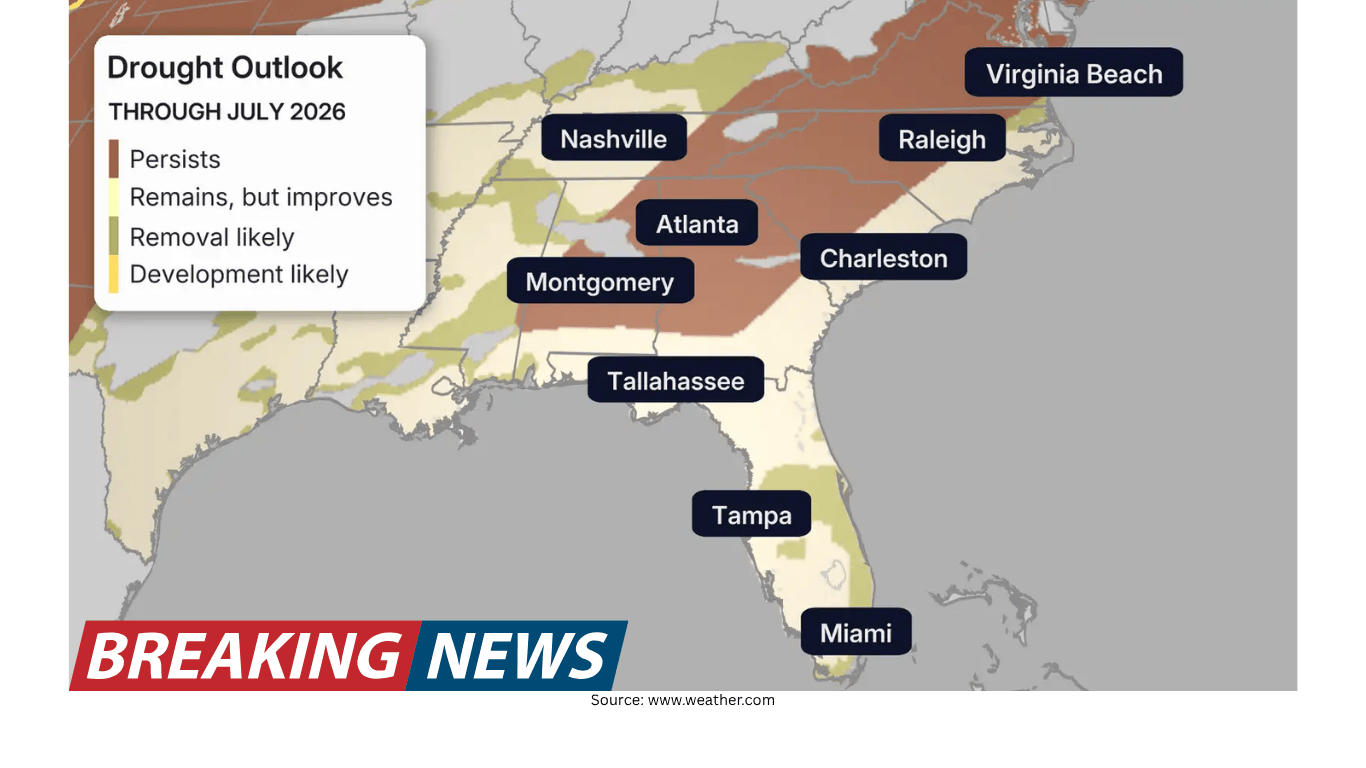
The bigger question for residents, farmers and travelers is whether the drought is likely to ease as summer approaches. The current outlook points in the opposite direction. Rather than a steady improvement, the drought is projected to worsen into the summer months, with particular concern for metro areas such as Atlanta, Charlotte, Raleigh, Montgomery and Richmond.
One reason is the scale of rainfall needed for full recovery. According to NOAA, much of the Southeast would need 15 to 25 inches of rain over a three-month period to eliminate the drought completely. That figure highlights why scattered showers or even a few stormy days may not be enough to meaningfully change the drought picture.
What a worsening drought can mean for summer conditions
Drought is not just a rainfall statistic; it can shape day-to-day summer weather and hazards. The summer could end up hotter than average in a part of the country that is already known for heat. Dry ground can contribute to hotter conditions by reducing the amount of energy used for evaporation and increasing the amount that goes into warming the air near the surface.
At the same time, fire danger is expected to increase. The combination of dry fuels, hot weather and low relative humidity can create conditions where fires start more easily and spread faster. Gusty winds can further fan flames, turning small fires into fast-moving threats.
Wildfire risk: planning matters, especially for visitors
As drought deepens, wildfire risk becomes a more prominent concern across the Southeast. While some travelers may associate wildfires primarily with other parts of the United States, drought-stricken landscapes in the Southeast can also support dangerous fire behavior under the right conditions.
For anyone vacationing in drought-affected parts of the region—particularly those who are not familiar with wildfire risks—having a plan in place is important. That includes knowing how to receive local alerts and being prepared to evacuate if conditions change quickly.
Dry vegetation, low humidity and wind can combine to create rapid changes in fire conditions. In that context, preparedness is not alarmist; it is a practical step during a dry and potentially hot summer.
Soil moisture is low, with implications for agriculture
Beyond heat and fire, the drought is also reflected in low soil moisture across the Southeast. Soil moisture is a key indicator for agriculture because it affects crop development and the need for irrigation. When soils remain dry over an extended period, it can increase stress on crops and raise costs and challenges for producers.
Low soil moisture also tends to make the landscape more vulnerable to heat spikes. When the ground is dry, it can take longer for conditions to recover even after rainfall, particularly if temperatures are high and evaporation rates increase.
Water resources under pressure and restrictions in parts of Florida
Water availability is another growing concern. Low water levels have already led to some water restrictions, particularly in parts of Florida, according to drought.gov. Restrictions are often an early sign that water systems are under strain and that communities are working to conserve supplies ahead of peak summer demand.
For residents, that can mean changes in outdoor watering rules or other conservation measures. For visitors, it can affect expectations for activities and local conditions, especially in areas where water resources are closely managed during prolonged dry periods.
What to watch in the weeks ahead
With drought conditions widespread and the seasonal outlook pointing toward further deterioration, the next several weeks will matter. The near-term rain may offer localized improvements, but the broader picture is shaped by the magnitude of the precipitation deficit and the amount of rain needed for full recovery.
Key themes to monitor include:
- Whether the expected rainfall over the next week materializes in the areas with the most severe drought, including Florida and Georgia
- How quickly temperatures rise heading into summer, particularly if the season trends hotter than average
- Any increase in wildfire activity as dry fuels and low humidity persist
- Changes in soil moisture and agricultural conditions as the dry pattern continues
- Additional water restrictions if low levels persist, especially in parts of Florida
The Southeast is entering summer with drought already entrenched across most of the region. While intermittent rain can help, the amount needed to fully erase deficits is substantial. In the meantime, the practical impacts—heat, wildfire risk, low soil moisture and water management challenges—are likely to remain central concerns through the summer months.