
A Key Atlantic Ocean Current May Slow Faster Than Expected — What That Could Mean for Weather and Climate
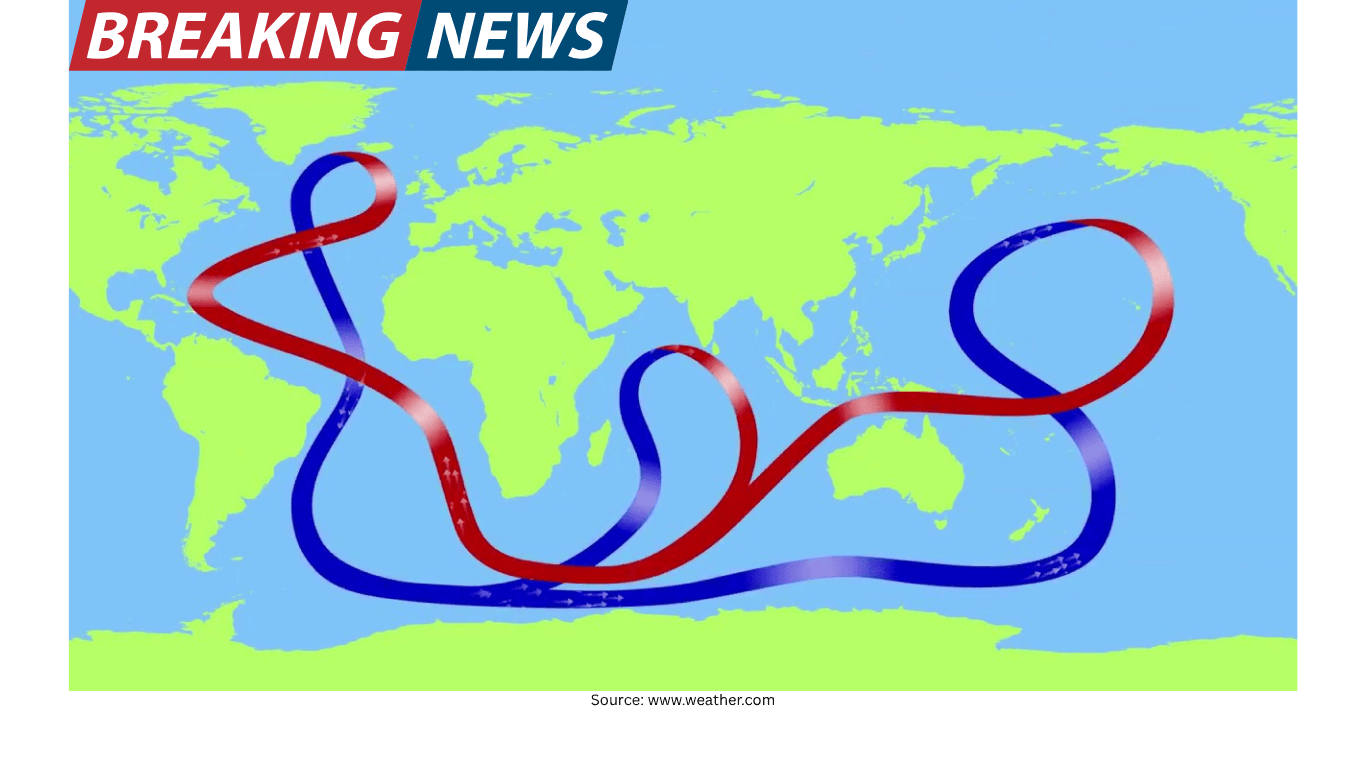
An ocean “conveyor belt” that shapes weather
A vast system of ocean currents in the Atlantic helps regulate weather and climate far beyond the ocean itself. Scientists have long expected this circulation to weaken as the planet warms, but new research suggests the slowdown could be sharper — and could approach critical thresholds sooner — than many earlier estimates indicated.
The system at the center of this research is the Atlantic Meridional Overturning Circulation, often shortened to AMOC. It is sometimes described as a conveyor belt because it continuously moves water through the Atlantic Basin in a large-scale loop. Near the surface, it carries warm, salty water from the tropics northward. At depth, it returns colder, denser water southward.
This motion is not just an oceanographic detail. By transporting heat, the AMOC helps distribute energy around the planet. That heat distribution influences global temperatures, rainfall patterns, and a range of weather behaviors that people experience on land. When the circulation changes, the impacts can extend to water supplies, agriculture, coastal flooding risk, and even storm intensity.
What the new research found
A study published in Nature suggests the AMOC could slow by as much as 50% by the year 2100. That magnitude of weakening is larger than many earlier projections. The findings also raise a crucial point about timing: the decline may not unfold in a smooth, predictable way.
Instead of a steady, gradual weakening, the research indicates the system could move toward critical thresholds earlier than expected. That matters because approaching a threshold can increase the risk of abrupt changes, where the circulation shifts more quickly than planners and communities might anticipate.
The study narrowed uncertainty by combining two kinds of evidence:
Model simulations that represent how the ocean and climate system might evolve under warming conditions.
Real-world observations, including patterns in ocean temperature and salinity, which help evaluate whether models capture key features of the Atlantic.
While a full collapse of the AMOC this century is still considered unlikely, the study emphasizes that even a substantial weakening could have wide-reaching consequences.
How the AMOC works — and why slowing matters
In its typical state, the AMOC moves warm water northward near the ocean surface. That water is relatively salty. As it travels, it can cool, become denser, and sink, feeding the southward return flow at depth. This sinking of dense water is a critical driver of the circulation’s strength.
If the AMOC slows, the distribution of heat changes. Warm water would be more likely to remain closer to the tropics, while cooler water would be more likely to remain farther north. Because the AMOC helps set up temperature contrasts across the Atlantic, a slowdown can ripple outward into atmospheric patterns that guide storms and rainfall.
In practical terms, a weaker AMOC is not simply “less current.” It implies a different arrangement of ocean temperatures, and those temperature patterns can influence weather systems that affect millions of people.
Potential impacts: sea level, storms and coastal flooding
One concern highlighted in the research is the U.S. East Coast. Changes in Atlantic circulation can contribute to faster sea-level rise along parts of the coastline, increasing the risk of coastal flooding. Sea level is influenced by multiple factors, and the study points to ocean circulation as one mechanism that can worsen local or regional impacts even when global averages provide only part of the picture.
Across the wider Atlantic Basin, altered temperature patterns may influence storm tracks and storm intensity. When the ocean’s heat is distributed differently, the atmosphere above it can respond in ways that shift where storms tend to form and travel. The study also notes that marine ecosystems could be affected, reflecting how strongly ocean temperature patterns shape life in the sea.
Europe could see a different kind of change
The AMOC’s role in moving heat northward is one reason it is often discussed in relation to European climate. According to the research, a weaker AMOC could counteract some global warming in Europe, leading to cooler regional temperatures, especially in northern areas.
This does not mean global warming would stop. Rather, it suggests regional outcomes can differ from the global average. A world that is warming overall can still experience regional cooling influences if a major heat-transport system weakens.
At the same time, shifting ocean heat patterns can have consequences beyond temperature alone. Changes in where heat is stored in the ocean can affect atmospheric circulation, which in turn can influence precipitation patterns and the paths storms take.
Tropical rainfall and monsoon systems
The study also points to potential disruption of rainfall in the tropics. Tropical rainfall patterns are closely linked to ocean temperatures, and changes in the Atlantic’s heat distribution could alter monsoon systems that billions of people rely on.
Monsoons are not simply “rainy seasons.” They are large-scale shifts in winds and precipitation that support water supplies, agriculture and daily life across vast regions. The research underscores that changes in the Atlantic can have consequences far from the North Atlantic itself, because the climate system is interconnected.
Polar temperature shifts described in the research
One of the more striking points in the extracted findings is the possibility of large temperature changes at the poles associated with an AMOC slowdown. Scientists suggest that temperatures in the Arctic could cool by nearly 11 degrees Fahrenheit (6 degrees Celsius), while the Antarctic could warm by more than 12 degrees Fahrenheit (7 degrees Celsius).
These figures illustrate how reorganizing ocean heat transport can produce uneven effects across the planet. Rather than a uniform warming or cooling, changes in circulation can redistribute heat in ways that amplify warming in one region while reducing it in another.
The ocean’s role in the carbon budget
The ocean is also a major carbon reservoir. Over the decades, it has absorbed roughly a quarter of carbon dioxide emissions. The extracted content notes that a change in ocean circulation could create problems for the carbon budget and could warm the planet as a whole by about 0.36 degrees Fahrenheit (0.2 degrees Celsius).
This point matters because it links circulation not only to weather patterns and regional temperature shifts, but also to how the planet stores and moves carbon. If the ocean’s ability to absorb carbon changes, that can influence the overall trajectory of warming.
Why earlier projections may have underestimated the slowdown
Climate models have long agreed on the direction of change — weakening as warming continues — but estimates of speed and magnitude have varied widely. The extracted content explains one reason: subtle biases in how models simulate ocean conditions.
Small errors in salinity and temperature, particularly in key Atlantic regions, can have outsized effects on how dense water moves and sinks. Because the sinking of dense water is a critical driver of the AMOC, even modest model inaccuracies can translate into meaningful differences in projected circulation strength.
The new research attempts to reduce this uncertainty by combining model simulations with observed patterns of temperature and salinity. That approach is intended to better constrain the range of plausible futures, even as questions remain about exactly how the AMOC will evolve.
What scientists can measure — and what remains uncertain
There are already signs the AMOC has weakened compared to its historical strength. However, direct measurements span only the past couple of decades. That limited record makes it difficult to determine how close the system may be to a tipping point.
This measurement challenge is central to the story. The AMOC is a large, complex circulation pattern that varies over time, and the strongest evidence for long-term change requires long-term observation. When direct measurement records are short, scientists must rely more heavily on indirect indicators and models — tools that are powerful, but that also come with uncertainty.
Even so, the extracted findings add to growing evidence that this critical part of Earth’s climate system may be more vulnerable than once thought. The implication is not that a single outcome is guaranteed, but that the range of potentially disruptive outcomes may be broader — and could arrive sooner — than many people assume when they hear about changes projected for the end of the century.
Why this matters for everyday planning
The AMOC can sound abstract, but the consequences described in the research connect to everyday concerns. Water supplies and farming depend on reliable rainfall patterns. Coastal communities depend on understanding flood risk and sea level changes. Storm tracks and intensity influence infrastructure planning, insurance costs and emergency preparedness.
What makes the AMOC especially important is that it is a “system-level” feature of the planet. It does not affect only one coastline or one country. It influences how heat is distributed, and that distribution helps shape weather patterns across regions.
The research also highlights a broader lesson: climate change is not only about a steady rise in average temperature. It can involve shifts in the systems that move heat and moisture around the world — and those shifts can produce uneven, sometimes counterintuitive regional outcomes.
Key takeaways
The Atlantic Meridional Overturning Circulation (AMOC) is a major ocean current system that transports warm water northward near the surface and returns colder, denser water southward at depth.
New research suggests the AMOC could slow by as much as 50% by 2100, a sharper weakening than many earlier projections.
The decline may approach critical thresholds earlier than expected, raising the risk of abrupt changes rather than a smooth, gradual slowdown.
A substantial weakening could affect sea level along the U.S. East Coast, influence storm tracks and intensity, and disrupt marine ecosystems.
Europe could see cooler regional temperatures, especially in northern areas, even as the planet continues warming overall.
Shifts in ocean heat patterns could disrupt tropical rainfall and monsoon systems that billions of people rely on.
The ocean has absorbed roughly a quarter of carbon dioxide emissions over the decades; circulation changes could affect the carbon budget and add about 0.2°C (0.36°F) of warming globally.
Direct measurements cover only the past couple of decades, making it hard to know how close the AMOC may be to a tipping point.
As scientists continue to refine models and expand observations, the AMOC remains a focal point for understanding how warming can reshape the planet’s circulation patterns — and, with them, the weather conditions societies depend on.